

Account-Based Marketing Services are designed to help B2B companies focus on high-value accounts instead of relying on broad lead generation.
Your sales team has a list of 40 accounts that would change your revenue trajectory this year. Your marketing team is sending them the same email sequence you send everyone else. Nobody’s lying to you when they say “we do ABM” — they’re just doing personalization theater. A merge tag with the company name isn’t account-based marketing. It’s mail merge with better branding.
If you’re reading this, you’ve probably already tried the DIY version and hit a wall: no bandwidth, no intent data pipeline, no real account intelligence, and a sales team that’s stopped trusting marketing leads. That’s usually the exact moment companies start looking at account-based marketing services instead of trying to force it internally.
Account-based marketing services help B2B companies target, engage, and convert a defined list of high-value accounts instead of running broad lead gen. Most teams either build ABM in-house (slow, resource-heavy) or hire an ABM agency/consultant (faster execution, but requires vetting). The right choice depends on your account list size, sales cycle length, and internal RevOps maturity. Below: how ABM services actually work, what separates a real ABM provider from a rebranded demand-gen shop, what it costs, and how to pick one without wasting a quarter.
What Are Account-Based Marketing Services, Really
Account-based marketing services are the strategy, technology, and execution work a company pays a specialist provider for to run 1:1, 1:few, or 1:many campaigns against a defined list of target accounts.
That’s the textbook definition. Here’s the practitioner version: ABM services exist because ABM is operationally hard. It’s not a campaign type — it’s a cross-functional discipline that touches your CRM, your ad platforms, your content team, your SDRs, and your sales leadership’s account planning, all at once. Most internal marketing teams have the strategy knowledge but not the operational bandwidth to run all of that simultaneously while still keeping the lights on for everything else.
A genuine ABM service provider handles some combination of:
- Account selection and scoring — identifying which companies in your total addressable market are actually worth the personalization investment
- Buying committee mapping — finding and profiling the 6-10 people at each account who influence the deal
- Intent and signal monitoring — tracking when target accounts start researching solutions like yours
- Personalized content and campaign execution — building assets and sequences tailored to account clusters, not generic personas
- Sales-marketing orchestration — making sure marketing’s account activity actually reaches the rep working that account, in real time
- Attribution and reporting — proving pipeline influence at the account level, not just lead-level vanity metrics
If a provider’s pitch stops at “we’ll run LinkedIn ads targeting your account list,” that’s paid media with an ABM label on it. Real ABM services connect targeting, content, sales enablement, and measurement into one motion.
Why Companies Outsource ABM Instead of Building It In-House
Three reasons come up again and again when I talk to marketing leaders who’ve made the switch.
First, the tooling learning curve is brutal. Intent platforms, account scoring models, and orchestration tools like 6sense or Demandbase have real depth. Getting genuine signal out of them — not just dashboards nobody checks — takes months of tuning most internal teams don’t have time for.
Second, internal teams are structurally built for demand gen, not ABM. Your content calendar, your campaign cadence, your reporting rhythm — all of it is usually optimized around volume: more leads, more MQLs, more traffic. ABM asks you to optimize around depth instead: fewer accounts, deeper engagement, longer nurture. That’s a different operating rhythm, and retrofitting an existing team to it is slower than most leadership teams expect.
Third, and this is the one nobody says out loud in the boardroom: sales trust is already damaged. If your SDRs have been burned by low-quality MQLs before, they’ve quietly stopped acting on marketing’s account signals. An outside partner with a track record can sometimes rebuild that credibility faster than an internal team can, simply because they’re being judged on pipeline outcomes from day one, not activity metrics.
None of this means in-house ABM is a bad idea. It means it’s a bigger internal investment than most companies budget for in year one — which is exactly why the market for account-based marketing services exists.
This is why many growing B2B companies invest in Account-Based Marketing Services instead of building everything in-house.
The Three Types of ABM Services (and Which One You Actually Need)
Different Account-Based Marketing Services are designed for different sales cycles and deal sizes.
Not every account-based marketing service does the same job. Providers generally fall into one of three models, and picking the wrong one wastes both budget and time.
1. One-to-One ABM Services
Built for a handful of strategic accounts — think 5 to 25 — where each account gets custom research, custom content, and a dedicated program. This is expensive per account but appropriate when a single closed deal materially moves your revenue number. Enterprise SaaS selling multi-million-dollar contracts lives here.
2. One-to-Few ABM Services
Accounts are grouped into clusters of 5-15 that share an industry, use case, or pain point, and campaigns are built at the cluster level rather than the individual account level. This is the sweet spot for most mid-market B2B companies — enough personalization to stand out, without the cost of true 1:1.
3. One-to-Many (Programmatic) ABM Services
Personalization at scale across hundreds of named accounts, driven heavily by intent data and marketing automation. This works when your total addressable market is large, and deal sizes are moderate — think mid-market SaaS with a $15K-$50K ACV.
Here’s the mistake I see constantly: companies buy a one-to-many programmatic engagement because it’s cheaper, when their actual deal size and sales cycle call for one-to-few. The result looks like ABM on a dashboard but performs like generic demand gen in practice. Matching the service model to your actual deal economics matters more than almost any other decision in this process.
What a Real ABM Engagement Looks Like, Month by Month
Most Account-Based Marketing Services follow a phased implementation model. Vague roadmaps are one of the biggest tells of a weak provider. Here’s roughly what a competent engagement actually looks like, so you know what to expect and what to push back on if a proposal skips steps.
Month 1 — Foundation. Account selection criteria defined jointly with sales, ideal customer profile refined using closed-won data (not just firmographic guesses), buying committee roles mapped for the top-priority accounts.
Month 2 — Infrastructure. Intent/signal tooling connected to your CRM, account scoring model built, sales and marketing alignment on what counts as a “sales-ready” account signal (this conversation alone prevents most future finger-pointing).
Month 3 — Launch. First wave of personalized content and campaigns goes live against a pilot segment of accounts — not the whole list. Good providers pilot before they scale.
Months 4-6 — Iterate. Engagement data starts coming back. Underperforming account clusters get cut or re-messaged. Sales gets a live view of account activity, ideally inside the CRM they already use, not a separate portal nobody opens.
Months 6+ — Scale and prove. Pipeline attribution reporting matures, and the program either expands to more accounts or narrows further based on what’s actually converting.
If a provider promises pipeline results inside the first 60 days, be skeptical. ABM is a compounding motion — it should be measurably faster than a from-scratch internal build, but it’s not instant.
Five ABM Tactics That Actually Move Accounts Toward Pipeline
Strategy decks are easy to write. What separates a real ABM program from a rebranded one is whether these five tactics actually show up in execution. Successful Account-Based Marketing Services combine these tactics to generate pipeline.
1. Personalized video outreach instead of cold email. A rep sending a 90-second recorded video addressing a specific account’s stated pain point consistently outperforms a templated cold email — mainly because it signals someone actually looked at that company before hitting send.
2. Account-specific microsites or landing pages. Instead of sending a target account to your generic homepage, a landing page referencing their industry, logo, and use case turns a cold click into a warmer one. This doesn’t need to be elaborate — even swapping a hero section based on the account’s vertical works.
3. Self-serve personalized demos. Buying committees often include people who’ll never take a live sales call early on. A recorded, account-specific product walkthrough lets them evaluate on their own time, which shortens the gap between first touch and sales conversation.
4. Dynamic, trigger-based email sequences. Static drip sequences don’t respect account-level signals. If someone at a target account visits your pricing page, that should trigger a different next email than someone who just opened a blog post.
5. Co-created content with existing customers. Case studies and testimonials built with accounts that match your ICP do double duty — they’re social proof for prospects and a relationship deepener for the customer who agreed to participate.
None of these require a massive budget. What they require is an account list specific enough that “personalized” means something more than inserting {{company_name}} into a template.
In-House vs. Agency vs. Consulting Partner: Honest Comparison
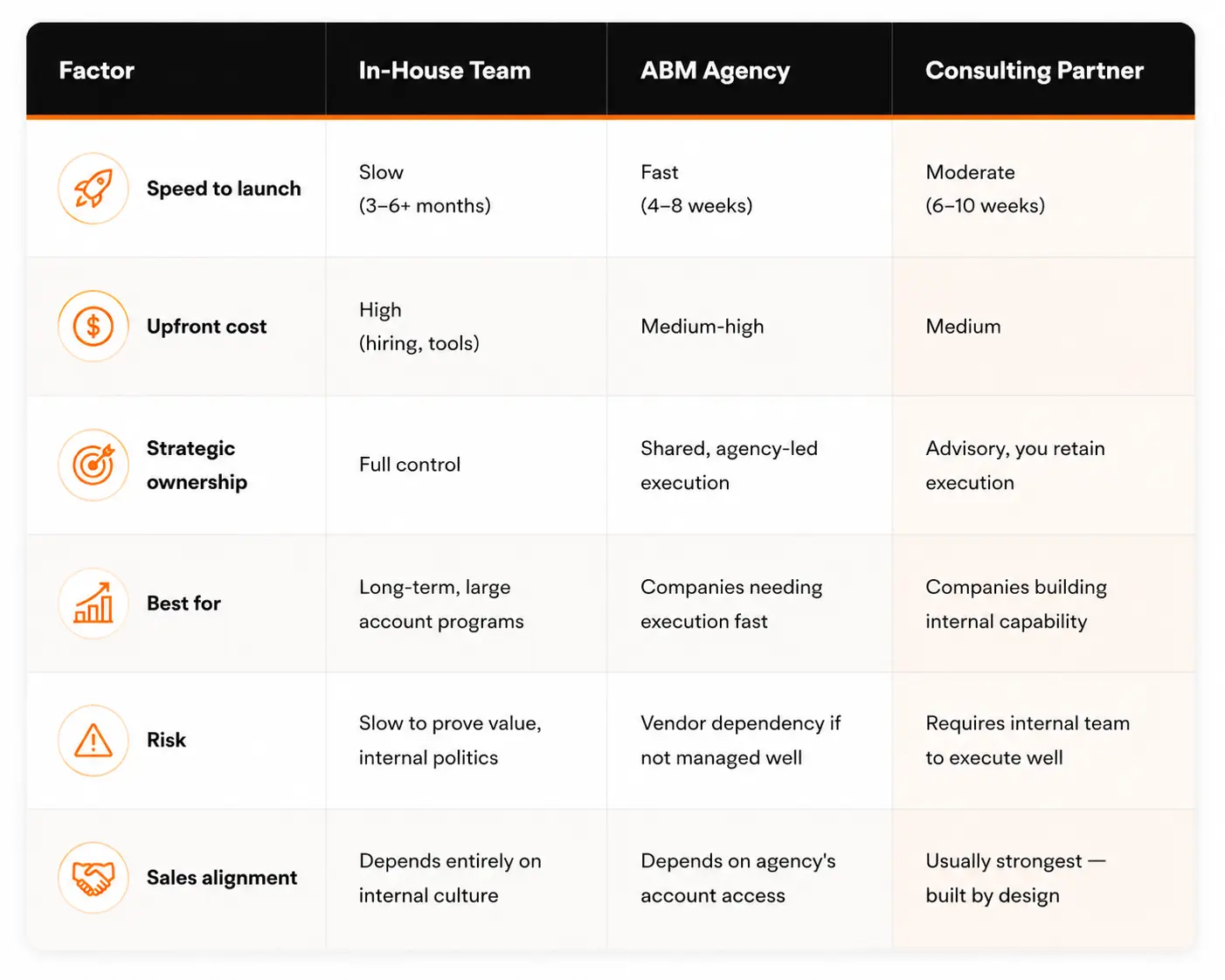
There’s no universally “right” answer here. Fast-growing companies without a mature RevOps function usually get more value from an agency or consulting partner in year one, then bring capability in-house once the playbook is proven. Larger enterprises with existing RevOps infrastructure sometimes only need a consulting layer to design the strategy and let internal teams execute.
What Account-Based Marketing Services Actually Cost
Numbers vary a lot by provider tier, but here’s a realistic range based on what’s currently in market:
- DIY tooling stack (intent data + enrichment + CRM orchestration, no agency): roughly $45K-$90K/year, all-in
- Boutique ABM agency, one-to-few program: $8K-$25K/month depending on account count and content volume
- Enterprise ABM agency or full-service partner: $25K-$60K+/month for large one-to-one or blended programs
- Consulting engagement (strategy + build, no ongoing execution): often a fixed project fee, commonly $15K-$50K for a 2-3 month build
The number that actually matters isn’t the monthly retainer — it’s cost per engaged account versus your average deal size. If your average contract value is $80K and a well-run ABM program costs $20K/month to influence 30 target accounts, the math usually works. If your ACV is $5K, a heavy ABM retainer rarely pencils out — and a decent provider will tell you that honestly instead of selling you the program anyway.
Investing in Account-Based Marketing Services should always be evaluated against your average contract value.
The Minimum Tech Stack Your ABM Provider Should Already Have
Modern Account-Based Marketing Services rely on a strong technology stack. Before you sign with any provider, ask what’s actually running under the hood. A program that looks personalized on the surface but runs on spreadsheets and manual list-building won’t scale past a handful of accounts.
At minimum, a competent ABM provider should have:
- An intent or signal platform (like 6sense, Demandbase, or similar) to flag when target accounts start actively researching solutions — not just visiting your website once.
- A prospecting/enrichment tool (like LinkedIn Sales Navigator or a B2B contact database) to keep buying committee data current, since job changes and org restructures happen constantly.
- CRM-native orchestration, not a separate dashboard. If your sales team has to log into a third tool to see account engagement, they won’t.
- A lead/account scoring model that factors in both firmographic fit and real-time intent — not just company size and industry.
- Video or async messaging capability for personalized outreach at the individual buying-committee-member level, which most text-only sequences can’t replicate.
- You don’t need to know how to operate these tools yourself. But if a provider can’t name their stack specifically when you ask, that’s usually a sign the “personalization” in their pitch deck isn’t backed by real infrastructure.
Red Flags: How to Spot an Agency That’s Just Rebranded Demand Gen
This is where most buying mistakes happen, so it’s worth being blunt.
- They can’t explain their account scoring methodology beyond firmographics. Real ABM factors in intent signals and buying committee engagement, not just “company size + industry.”
- Every case study is a lead-volume metric, not pipeline or closed-won revenue tied to named accounts.
- They propose the same content calendar structure they’d use for a demand gen retainer, just aimed at a smaller list.
- There’s no sales enablement component in the proposal. ABM without a sales orchestration plan is marketing running solo, which defeats the entire premise of the discipline.
- They can’t tell you how they’ll integrate with your existing CRM and instead want you to log into a separate dashboard.
None of these disqualify a provider automatically, but two or more together usually mean you’re buying targeted demand gen with an ABM label, not ABM itself.
Questions to Ask Before You Sign a Contract
Bring these into every vendor call — they cut through the pitch deck fast:
- How do you define a “sales-ready” account, and who decides — marketing or sales?
- Walk me through a client where the program underperformed. What did you change?
- How does your reporting show account-level pipeline influence, not just engagement?
- What’s your typical pilot size before scaling to a full account list?
- Who on your team actually does the buying committee research — a strategist or a junior analyst?
Good providers answer these specifically, with real numbers and real anecdotes. Vague answers here are a preview of vague reporting later.
What a Well-Run ABM Program Actually Looks Like in Practice
Everything above is easier to evaluate with a real example in front of you.
A US-based energy SaaS company came in with a familiar problem: a long list of priority accounts, but no infrastructure to turn that list into a repeatable pipeline motion. The fix wasn’t a generic campaign — it started with deep account-level research across roughly 100 priority accounts, building organization maps, technology stack profiles, and whitespace analysis for each one. That groundwork is what separates real ABM from a targeted ad campaign wearing an ABM label.
From there, intent signal infrastructure (using tools like factors.ai and Salesworx.ai) was layered in specifically to catch compliance- and efficiency-related research activity — the kind of signal that mattered for this account’s regulatory-heavy buyers. Outreach was timed around those signals instead of running on a fixed calendar cadence, and messaging was built separately for each buyer persona in the account (CIO, COO, Operations Director), rather than a single generic pitch sent to everyone in the buying committee.
The result: a 25% lift in conversions across the 100 priority accounts.
What’s worth noticing here isn’t just the number — it’s the sequence. Research first, infrastructure second, personalized execution third. Skip any one of those steps and the “lift” usually doesn’t show up. This is the same three-part sequence worth asking about in Section 8’s vendor questions above, and it’s exactly what the [Worxwide account-based marketing team](https://worxwide.com/account-based-marketing/) ran for this engagement
How to Measure Whether Your ABM Program Is Working
Standard demand gen metrics (MQLs, form fills, traffic) are close to useless for judging ABM. The metrics that actually matter:
- Account engagement depth — how many people at a target account are engaging, not just how many total touches
- Pipeline velocity for target accounts vs. non-target accounts — ABM should measurably shorten the sales cycle for accounts on the list
- Win rate on engaged vs. non-engaged target accounts — this is the number that proves the program is doing more than generating activity.
- Account-to-opportunity conversion rate, tracked at the account level in your CRM, not the lead level
If your provider (internal or external) can’t report on these four, the program is being run and measured like traditional demand gen wearing an ABM costume.
For a working reference on how this looks structured end-to-end for a real B2B org, Worxwide’s account-based marketing approach breaks down the account scoring and sales alignment framework in more operational detail than most agency pitch decks bother to.
The success of Account-Based Marketing Services should always be measured at the account level rather than the lead level.
ABM Around the World: USA, Europe, and Global Considerations
ABM isn’t executed identically everywhere, and a provider that’s only run programs in one region can miss real operational differences.
United States: The most mature ABM market by volume of tooling and case studies. Buyers here are used to heavy personalization and multi-channel orchestration (LinkedIn, email, direct mail, retargeting all at once), so the bar for “personalized enough to notice” is higher than most other regions. Sales cycles in US enterprise SaaS also tend to involve larger buying committees, which makes the buying-committee-mapping step non-negotiable.
Europe: Data privacy requirements (GDPR) directly shape how intent data and account-level tracking can be collected and used, which means an ABM provider without hands-on GDPR experience will build a program that either underperforms or creates compliance risk. Multi-language content requirements also come up far more often than US-based providers expect.
UAE and broader Middle East: ABM adoption is newer, and relationship-driven sales culture means account-based approaches often blend digital personalization with more traditional relationship marketing than a pure US-style program would.
Global companies selling across regions generally need a provider who can run one coherent account strategy with region-specific execution underneath it — not three disconnected regional campaigns that happen to share a logo. That coordination layer is exactly where a lot of internal teams struggle and where an experienced partner earns its retainer.
Getting Started
If you’ve read this far, you’re probably past the “what is ABM” stage and into the “which path do we actually take” stage. That’s the right place to be before you commit budget.
The honest next step, whether you build in-house, hire an agency, or bring in a consulting partner, is the same: define your account selection criteria and get sales and marketing agreeing on what a “target account” actually means before any campaign gets built. Everything downstream depends on getting that part right.
Choosing the right Account-Based Marketing Services partner can significantly improve revenue growth and sales alignment.
If it’s useful to see how this looks as a structured, sales-aligned program rather than a slide deck, Worxwide Consulting’s account-based marketing services walk through the account scoring, buying committee mapping, and reporting framework used in real B2B engagements — worth a look before you finalize how you want to run this.
